
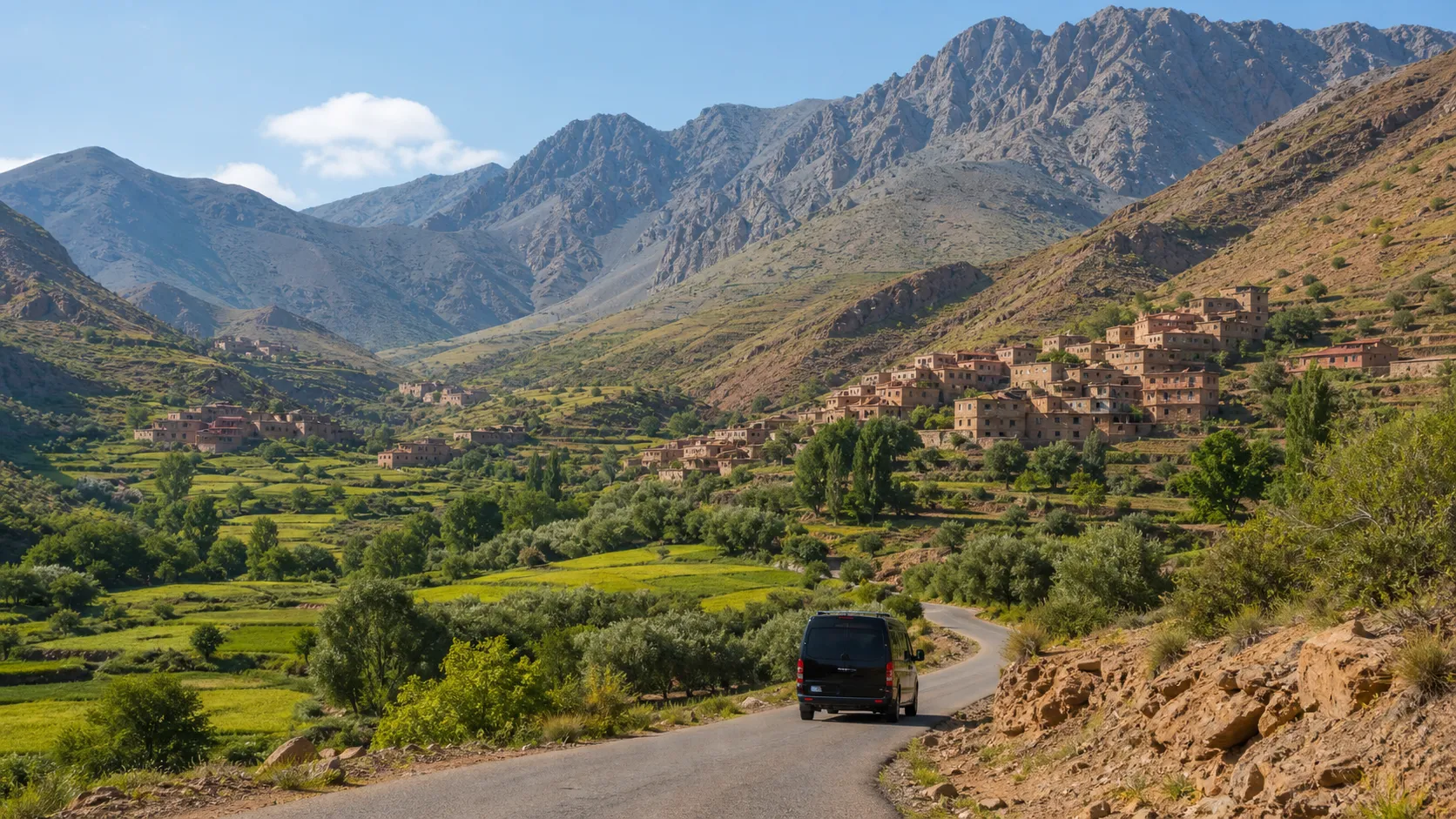
Plan Marrakech to Aït Bouguemez with scenic stops, reliable places to eat, and practical advice for buying valley food products and crafts.
The road from Marrakech to Aït Bouguemez leaves the Haouz plain, passes the old mountain town of Demnate and climbs into one of the Central High Atlas's most rewarding valleys. The regional tourism guide places the journey at about 180 kilometres via Demnate and the Imi n'Ifri natural bridge. Distance alone is misleading: winding mountain roads make this a four-and-a-half to six-hour drive before sightseeing stops, so the best plan includes an early start and at least one night in the valley.
Marrakech to Aït Bouguemez at a glance
| Route detail | Practical answer |
|---|---|
| Common spellings | Aït Bouguemez, Aït Bougmez and Ait Bouguemaz |
| Scenic route | Marrakech → Demnate → Imi n'Ifri → Aït Bou Oulli → Tabant |
| Distance | About 180 km via Demnate |
| Direct driving time | Roughly 4.5–6 hours, depending on weather and road conditions |
| Comfortable travel day | 7–9 hours with breakfast, Imi n'Ifri and photo stops |
| Best plan | Stay at least one night in Aït Bouguemez |
Online maps can underestimate this journey because the final mountain sections are slow. Road surfaces and conditions may change after rain, snow or maintenance, so treat timings as a planning range rather than a promise. A private driver who knows the route can confirm the best approach on the day and keep the sightseeing stops within daylight hours.
The best stops on the road
1. Demnate: breakfast, supplies, fuel and cash
Demnate is the most useful service stop before the High Atlas section. Fill the tank, withdraw cash and buy water here; the official valley guide notes that the nearest reliable fuel stations and bank counters are in Demnate or Azilal, while many valley guesthouses still prefer cash. A busy local café is also a better place for breakfast than waiting for the remote road ahead.
For a quick meal, order msemen, eggs, bread, olive oil and mint tea in the morning, or a simple tagine, lentil soup or grilled brochettes later in the day. Ask what is already prepared if you want to keep moving; a tagine cooked from the beginning needs time.
2. Imi n'Ifri: the natural bridge below Demnate
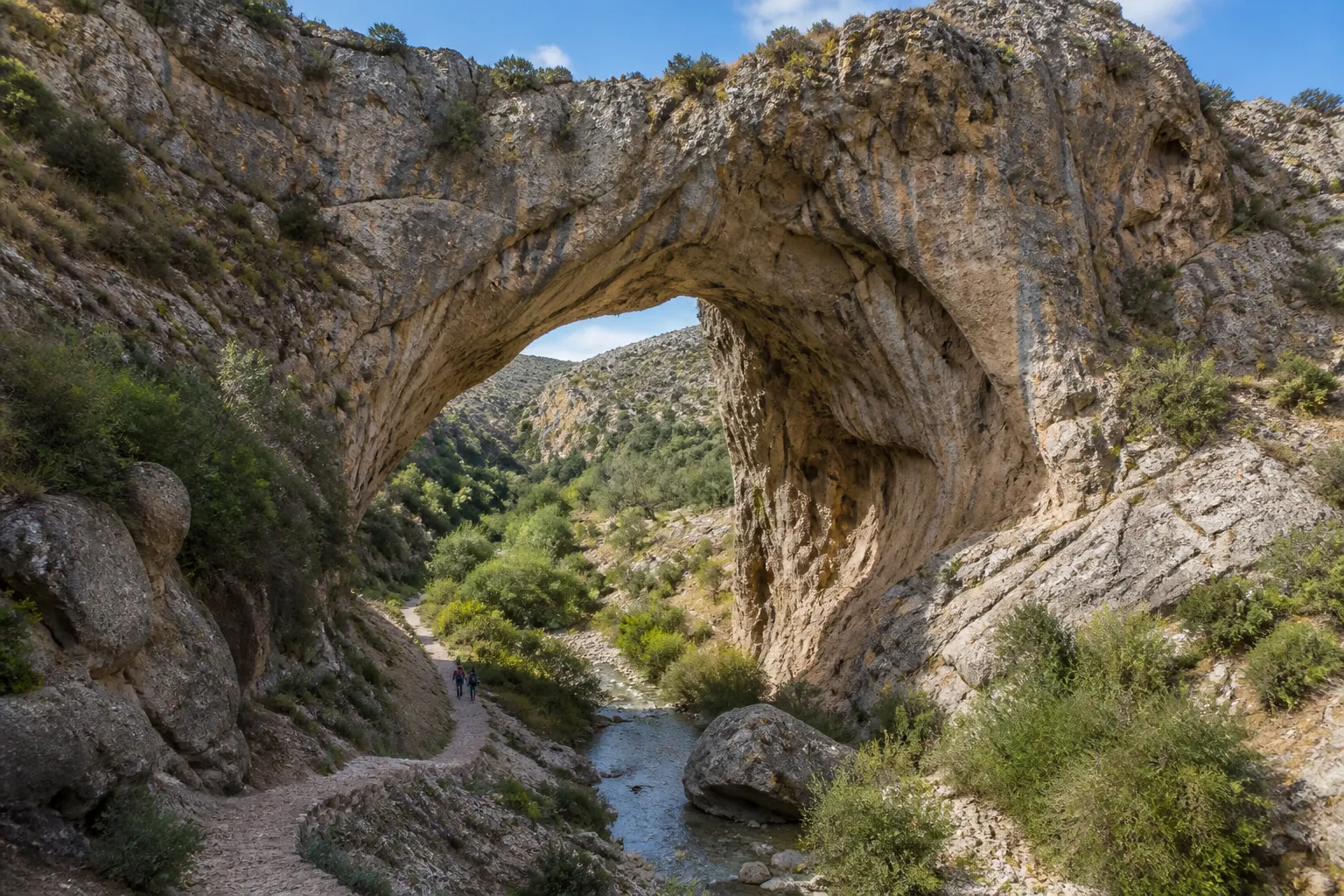
Imi n'Ifri is the route's signature stop and one of the geosites promoted by Morocco's national tourism office. The enormous natural rock bridge spans a narrow gorge just outside Demnate. A viewpoint is easy to include, while descending beneath the arch takes longer and involves uneven, sometimes slippery steps and stones.
- Allow 30 minutes for the viewpoint or 60–90 minutes for a careful descent and return.
- Wear shoes with grip and avoid the lower path during heavy rain or poor light.
- Use a local guide if you want help with the rougher section or an explanation of the geology.
3. Aït Bou Oulli and the mountain approach
Beyond Imi n'Ifri, the road enters quieter mountain country and passes the Aït Bou Oulli valley before climbing toward Aït Bouguemez. Earth-built villages, exposed ridges and cultivated terraces make this the most scenic part of the drive. Services are limited, so photograph from a safe pull-off agreed with your driver rather than stopping on a blind bend.
This stretch is also where weather matters most. In winter, snow can interrupt the road for several hours; after strong rain, small floods or fallen material may slow traffic. Leave Demnate with water, a full tank and enough daylight to arrive without rushing.
Popular places to visit in Aït Bouguemez
Sidi Moussa granary and the Timit viewpoint
The circular Sidi Moussa granary stands on a conical hill above Timit and is one of the valley's defining landmarks. The short climb opens a broad view over orchards, fields and earthen villages. The site also has a small museum, and the regional guide notes that visitors may be able to take tea with the guardian or picnic nearby. Confirm access locally and carry small cash.
Ibaqualliwn dinosaur footprints
Around two kilometres from Tabant, limestone slabs at Ibaqualliwn preserve tracks attributed to plant-eating sauropods and three-toed theropods. The site belongs to the M'Goun UNESCO Global Geopark and is far more meaningful with a local guide who can identify the prints without visitors walking across the most sensitive surfaces.
Tabant and its Sunday souk
Tabant is the valley's practical centre for cafés, groceries, a bakery and the weekly market. The Sunday souk generally runs from morning into the afternoon and is the best moment to see regional produce in one place. Arrive early for the broadest choice, ask before photographing people and remember that the market is a local service first, not a staged attraction.
Where to eat along the way and in the valley
Eat breakfast or an early lunch in Demnate if you want the most flexible schedule. After that, roadside choices become less predictable. Pack water and a light snack, but leave room for a home-style dinner in the valley; many gîtes and guesthouses cook for residents and outside visitors when given notice.
In Tabant, the regional guide lists Restaurant Es-Salaam for a straightforward local meal. Campus vivant'e, below the Sidi Moussa hill in Ichougane, operates a café and prepares meals using local organic produce while supporting hospitality training; visits and meals should be arranged ahead. Cafés in Tabant and Agouti are useful for coffee or mint tea, and your accommodation can usually prepare tagine, couscous, soup, bread and a seasonal breakfast if you confirm the time.
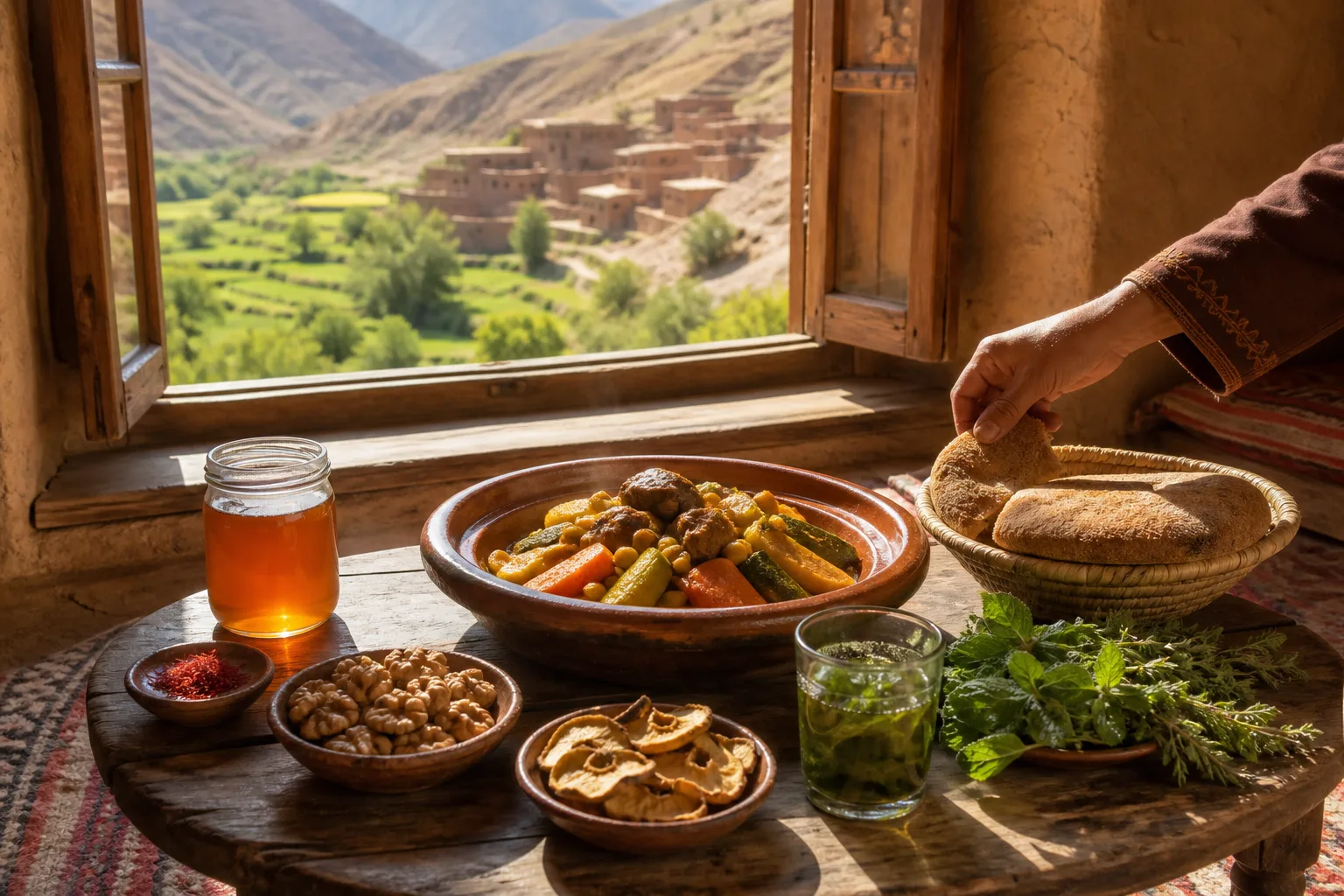
- Good to order: vegetable or lamb tagine, couscous when prepared, lentil soup, local bread, walnuts, honey and mint tea.
- Reserve ahead: guesthouse kitchens buy and cook for expected guests rather than running like city restaurants.
- Dietary needs: explain allergies, vegetarian meals or children's portions when confirming the reservation.
What local products and souvenirs are worth buying?
Aït Bouguemez is known for orchards, walnut trees and wool traditions. The regional tourism guide recommends buying through valley cooperatives, where the useful choices include dried fruit, saffron, jams, honey, soap, aromatic or medicinal plants and local crafts. Apples and walnuts are especially connected with the valley landscape, although availability depends on the harvest season.
- Walnuts and dried fruit: choose clean, dry produce and a sealed bag for travel.
- Mountain honey and jam: look for the producer, origin, ingredients and net weight on the jar.
- Saffron and herbs: buy modest quantities from a cooperative that can explain where they were grown or gathered.
- Soap and plant products: check the ingredient list rather than relying on a fragrance or sales claim.
- Wool rugs and woven pieces: ask who made the item, what fibre and dyes were used, and how long the work took.
For a deeper connection, ask a guide or guesthouse about a women's weaving workshop or the Maison du Berger's wool activities. A paid workshop supports local knowledge more directly than aggressive bargaining over a finished piece. Never pick wild medicinal plants yourself, and do not buy geological fragments or fossils from protected sites.
Which itinerary fits your trip?
| Travel style | Suggested plan | Timing |
|---|---|---|
| Direct transfer | Breakfast in Demnate, one comfort stop, arrival in Tabant | 5–6 hours |
| Scenic transfer | Demnate, Imi n'Ifri and two safe mountain viewpoints | 7–9 hours |
| Two-day introduction | Travel day, overnight, Sidi Moussa and dinosaur footprints next morning | 2 days / 1 night |
| Local culture | Two nights with Sunday souk, weaving or cooking workshop and village walk | 3 days / 2 nights |
Practical preparation
- Check the mountain forecast and road conditions with your driver or accommodation before leaving Marrakech.
- Carry enough Moroccan cash; do not rely on cards or an ATM after Demnate or Azilal.
- Fill the tank before the mountain section and carry drinking water.
- Download the route and accommodation pin for offline use.
- Pack warm layers outside summer; the valley sits around 1,800–2,100 metres and nights can be cold.
- Use a licensed local guide for mountain hikes, gorges and remote trails.
Frequently asked questions
How long is the drive from Marrakech to Aït Bouguemez?
Allow roughly four and a half to six hours for a direct journey via Demnate. With Imi n'Ifri, meals and photo stops, seven to nine hours is more realistic.
Can Aït Bouguemez be visited as a day trip from Marrakech?
A same-day return would mean around ten or more hours of driving with almost no time in the valley. One night is the practical minimum; two nights allow a market, walk or cultural workshop without rushing.
Do we need a 4x4?
Most main roads are paved and a normal vehicle can often reach Tabant in good conditions. Weather, road works and side trips change the answer, so confirm the current route locally and do not take an ordinary car onto unverified mountain tracks.
Is the road open in winter?
It is often open, but snow can close or delay mountain sections for several hours. Check on the morning of travel, keep the itinerary flexible and avoid arriving after dark.
Which spelling should I use when searching?
Aït Bouguemez is used in the regional tourism guide, while Aït Bougmez and Ait Bouguemaz are common variants. They refer to the same High Atlas valley; the Boukhris Tours booking route uses Ait Bouguemaz.
A balanced first itinerary
Leave Marrakech early, eat breakfast and organise cash in Demnate, then visit the Imi n'Ifri viewpoint before continuing through Aït Bou Oulli. Reach your guesthouse before sunset and order dinner in advance. The next morning, visit Sidi Moussa and the Ibaqualliwn footprints with a local guide, then shop at a cooperative—or at Tabant's Sunday souk if the dates align—before deciding whether to return or stay a second night.
